What an award actually measures
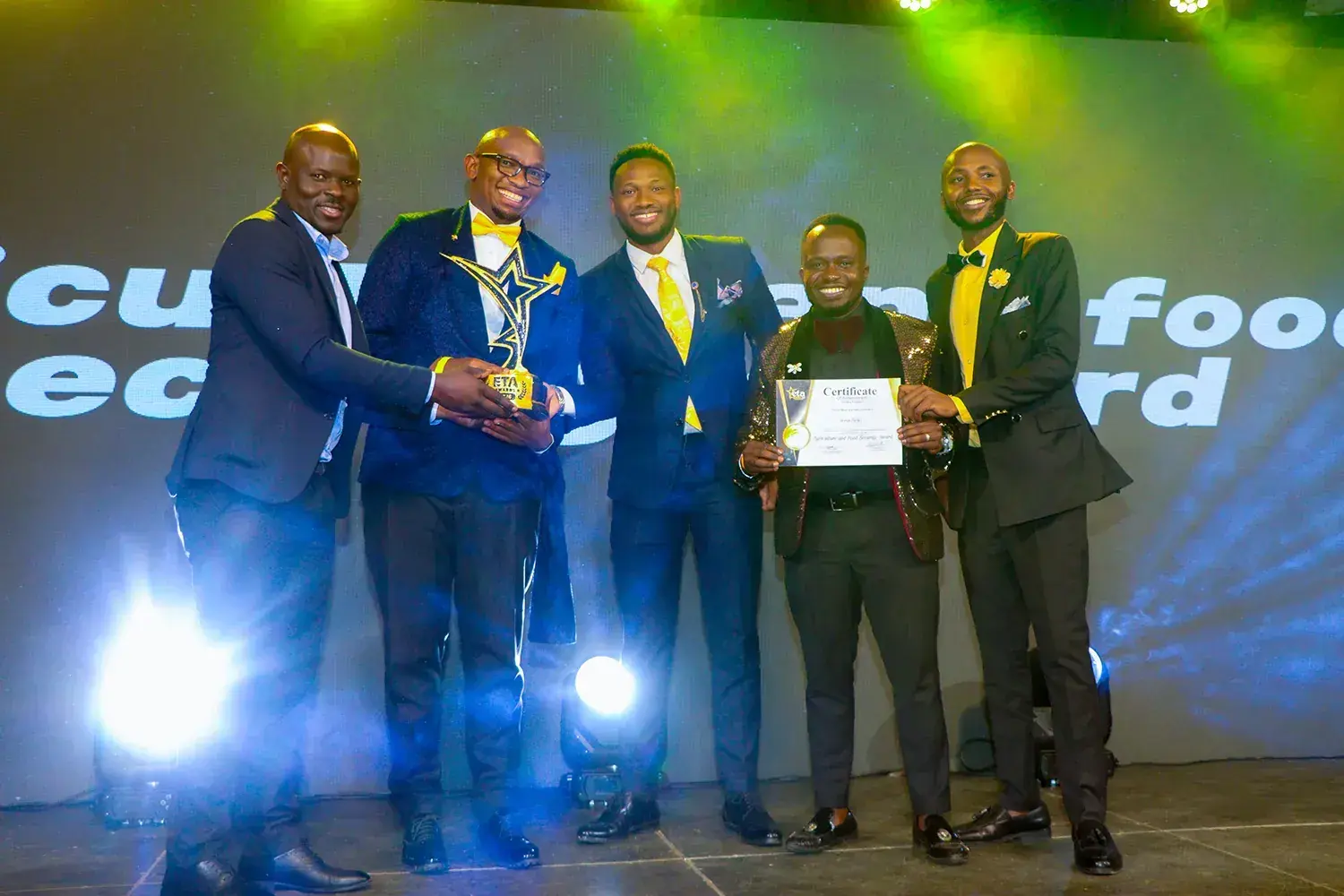
On the night we were given the Agriculture and Food Safety award at the ETA Awards 2026, the drip lines at Illasit were still running. Somebody had to check them in the morning. That is not humility, it is just what a farm is. The award changed nothing about the Tuesday.
What it did change is who is willing to take our call. So it is worth writing down plainly what the award was for, and what we intend to do with the attention.
What was actually judged
The Agriculture and Food Safety category is not a prize for a good idea. It is given to enterprises producing food and feed at a scale that can be verified, safely, with something to show for it on the ground.
What we put forward was a working farm at Illasit, in Kajiado South:
- Six crops in production. Maize, beans, sukuma wiki and cabbages for food, Juncao and Boma Rhodes for feed.
- A fodder enterprise selling Juncao planting material to farmers in other counties, with agronomy support after the consignment arrives.
- Silage work, putting up pits properly for neighbouring farms.
- A wage bill paid on time, at an agreed rate, to a team in which women earn the same as everyone else for the same work.
- Young people from the surrounding villages learning the trade on the farm itself.
Why this is a climate story, not only an agriculture one
Kajiado South is drying out. Rainfall is less dependable than it was a generation ago and dry spells run longer. When the grazing fails, livestock keepers here do not lose profit, they lose animals, and an animal is not a line in a ledger. It is a child's school fees.
Almost everything we do on this farm is a response to that, whether or not it gets described in those terms:
- Perennial fodder instead of annual scrambling. Juncao is planted once and cut for years. The root mass holds soil that would otherwise move in the first heavy rain, and the stand survives a dry spell that would finish an annual crop.
- Drip instead of flood. Every horticulture block here is on drip. In a district where water is the binding constraint, irrigating any other way is not a preference, it is a waste nobody can afford.
- Legumes in the system. Beans in rotation and desmodium between the fodder rows fix their own nitrogen, hold moisture in the soil and reduce the fertiliser bill that pushes smallholders out of production.
- Conserved feed as a buffer. Silage and baled hay are how a livestock keeper stops selling animals in a panic every time the rains are late. We help farmers put both up.
None of this is exotic. That is the point. It is adaptation built out of things a smallholder can actually obtain, on a farm they can walk to.
The part that matters most
Across this district there are young people who did what they were told. Finished school, went to Nairobi, looked for the job, did not find it, came home. They own or can access land, which is the asset most people spend a working life trying to buy, and nobody has ever shown them how to make it produce an income.
What happens next is predictable and it is happening now. Idleness, and then drink, and then something harder. It is not a failure of character. It is a failure of opportunity, and it is completely reversible.
Moran Farms was started by Siloma Stephen, who left a secure government job to come and do this, and who opens the furrows himself. That detail is not decoration. You cannot ask a young person to pick up a panga and believe there is a future in it while you stand at the edge of the field in clean shoes.
Teaching it beyond the fence line
A farm can only host so many people at once. The thing that scales is the knowledge, and that is where being part of Digital Moran CBO changes what is possible.
Digital Moran trains rural young people in digital skills. One of our own farm hands came here to work the land, learned the crops, then picked up a phone and started filming what he was doing. Every video on the Moran Farms social platforms is shot by him. He arrived with one trade and now has two.
That is the model in miniature. Somebody learns to cut Juncao at the right stage, and they also learn to film it, write it up and put it in front of ten thousand farmers who will never set foot on the farm. Practical agronomy, taught locally, distributed digitally, by the people who did the work.
What we want to build next
The farm pays its own way. What it cannot pay for is the cost of teaching people properly, because a trainee is not yet a productive worker and we will not pretend otherwise by calling unpaid labour an internship.
So this is what we are looking for a partner to help us do:
- Run structured training cohorts through a full crop cycle, with a stipend so that attending does not cost a young person the income they live on.
- Extend water storage and drip coverage so more of the farm produces through the dry season and trainees learn on a system that holds up.
- Put more land under Juncao and Boma Rhodes, so more planting material reaches drought affected counties.
- Build a deliberate intake route for adolescent girls and young women, who are usually counted last in rural agriculture.
- Put up modest facilities. Somewhere to sit, store tools and keep records. The difference between hosting ten people and hosting fifty.
The Monday afterwards
The trophy is in an office. The work it was given for is out in the field, and it carried on exactly as it did before.
We would rather show you that field than send you a deck. If you fund climate smart agriculture, youth livelihoods or women in agribusiness, come and walk the blocks with us.